
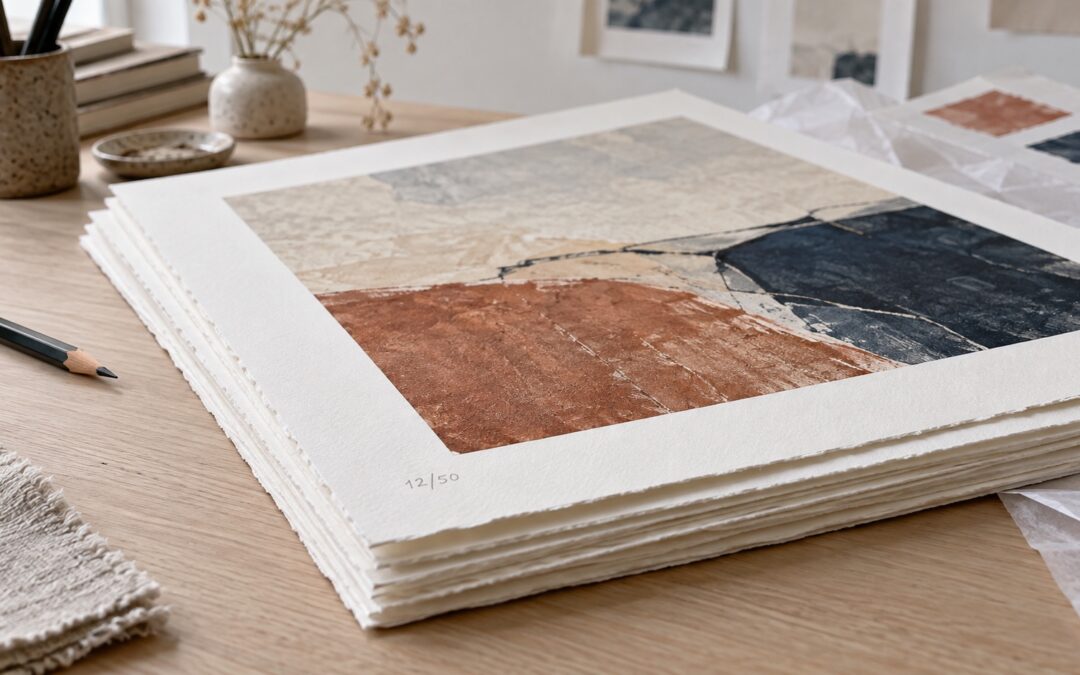
How to Make Limited Edition Giclée Prints of Your Artwork: A Complete UK Guide for Artists
Quick answer: To make limited edition giclée prints, you have your original artwork professionally scanned or photographed, approve a colour proof, choose an archival fine art paper, decide on a fixed edition size (for example 50), then sign and number each print in pencil and issue a certificate of authenticity. Once the edition sells out, you never reprint it at that size. Giclée London handles every production stage for artists across London and the UK, from scanning to finished, archival prints, with no minimum order.
This guide walks through each step in the order you will actually do it, with the practical detail that most artists only learn after their first print run.
What is a limited edition giclée print?
A limited edition giclée print is a fine art reproduction made on a professional pigment inkjet printer, produced in a fixed and declared quantity, and individually signed and numbered by the artist. “Giclée” (pronounced zhee clay) describes the printing method; “limited edition” describes the promise you make to buyers that no more than a set number will ever exist.
Three things separate a genuine limited edition giclée from a poster:
- Archival pigment inks rather than dye inks. At Giclée London we print with Canon archival pigment inks rated for over 100 years of lightfastness under normal display conditions.
- Museum grade paper that is acid free and usually 100% cotton, such as Hahnemühle Photo Rag or German Etching.
- A controlled, documented edition, with each print numbered (for example 7/50) and backed by a certificate of authenticity.
For a deeper look at the inks themselves, see our article What Is Archival Ink?
Step 1: Capture your original artwork
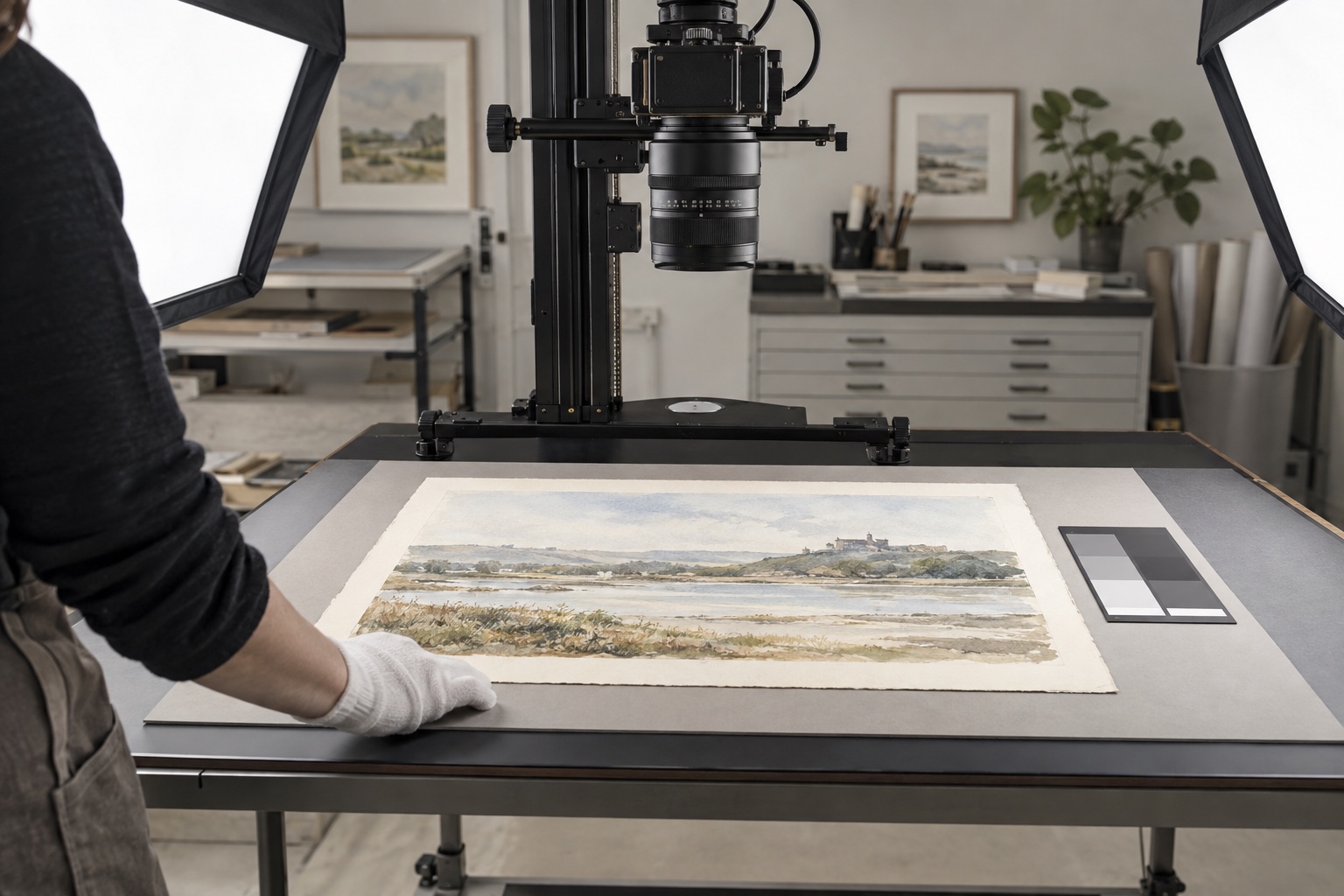
Every print can only be as good as the digital file behind it. You have two routes.
Professional fine art scanning
For flat work such as paintings, drawings, watercolours and illustrations, a professional scan captures texture, fine line and subtle colour far more faithfully than a phone or home scanner. Giclée London offers fine art scanning of original paintings, drawings and photographic slides, so the file is prepared specifically for print.
Supplying your own file
If you already have a digital file, these are the specifications that give the best results:
- Resolution: 300 PPI at the final print size.
- Format: TIFF is preferred; JPEG, PSD, PDF and PNG are also accepted.
- Colour mode: RGB, which preserves the widest colour range for pigment printing.
- Layers: flatten the file with all layers merged.
- Transfer: files up to 25MB by email; larger files via WeTransfer, Dropbox or FTP.
Step 2: Approve a colour proof before the edition
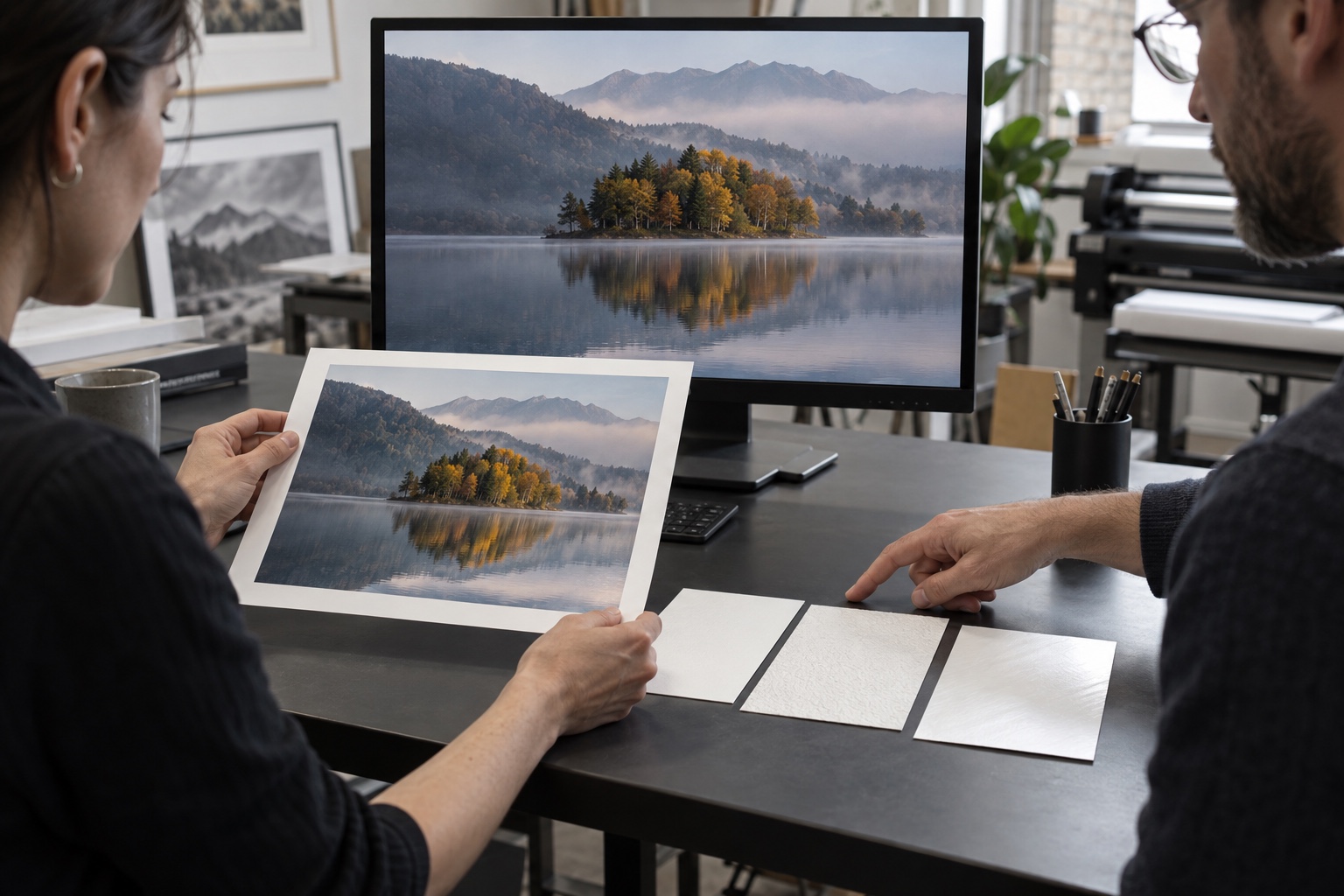
Never commit to a full edition without a proof. Screens vary enormously, and the way a colour looks on a backlit monitor is not how it will look on textured cotton paper under gallery lighting.
Giclée London offers both soft proofing (an on screen simulation of how the print will look on your chosen paper) and hard copy proofs (a physical test print). For a limited edition, a hard proof on the exact paper you plan to use is strongly recommended. The approved proof becomes the reference standard every print in the edition is matched against, and our printers are recalibrated monthly so that print number 50 matches print number 1.
Step 3: Choose the right paper for your edition
Paper choice shapes how collectors experience your work. The main decision is between smooth, textured and photographic surfaces.
| Paper | Surface | Best for |
|---|---|---|
| Hahnemühle Photo Rag | Smooth, matt, 100% cotton | Detailed drawings, illustration, pen and ink, fine line work |
| Hahnemühle German Etching | Distinctive textured, matt | Paintings, especially oils and acrylics, where texture adds depth |
| Hahnemühle William Turner | Textured, watercolour feel | Watercolours and loose, painterly work |
| Hahnemühle Fine Art Baryta | Satin, traditional darkroom feel | Black and white and colour photography |
| Innova and Origin cotton papers | Cold press, smooth and etching finishes | Excellent archival quality at a more accessible price |
| Origin Pearl 300gsm | Photographic pearl | Crisp, punchy photographic editions |
All of our fine art papers are acid free and archival rated for 80 to over 100 years under normal display conditions. If you are unsure, ask us for a paper sample pack and hold your options in your hand before deciding.
Tip: once you have chosen a paper for an edition, keep it the same for every print in that edition. Changing paper halfway through technically creates a different edition.
Step 4: Decide your edition size
The edition size is a commitment to your buyers. Smaller editions feel more exclusive and can justify a higher price per print; larger editions make your work accessible to more collectors. Common approaches used by UK artists include:
- Small editions of 10 to 25: suited to large format prints, established artists, or especially significant works.
- Mid editions of 50 to 100: the most common choice for artists building a collector base.
- Open editions: unlimited, unsigned or signed but not numbered, and usually priced lower. Many artists run an open edition at a small size alongside a limited edition at a larger size.
Two rules keep your edition honest. First, state the edition size publicly before you sell. Second, if you want to offer the same image at different sizes, treat each size as its own edition (for example “A2 edition of 50” and “A4 edition of 100”) and say so clearly.
Do I have to print the whole edition at once?
No. Because giclée is a digital process with no plates or setup costs, you can print on demand as orders come in. Giclée London has no minimum order, so you can print one copy of print 1/50 today and another next month, knowing that colour stays consistent against your approved proof. This keeps your cash flow healthy and means you are not storing unsold stock.
Step 5: Sign, number and document each print
Signing and numbering
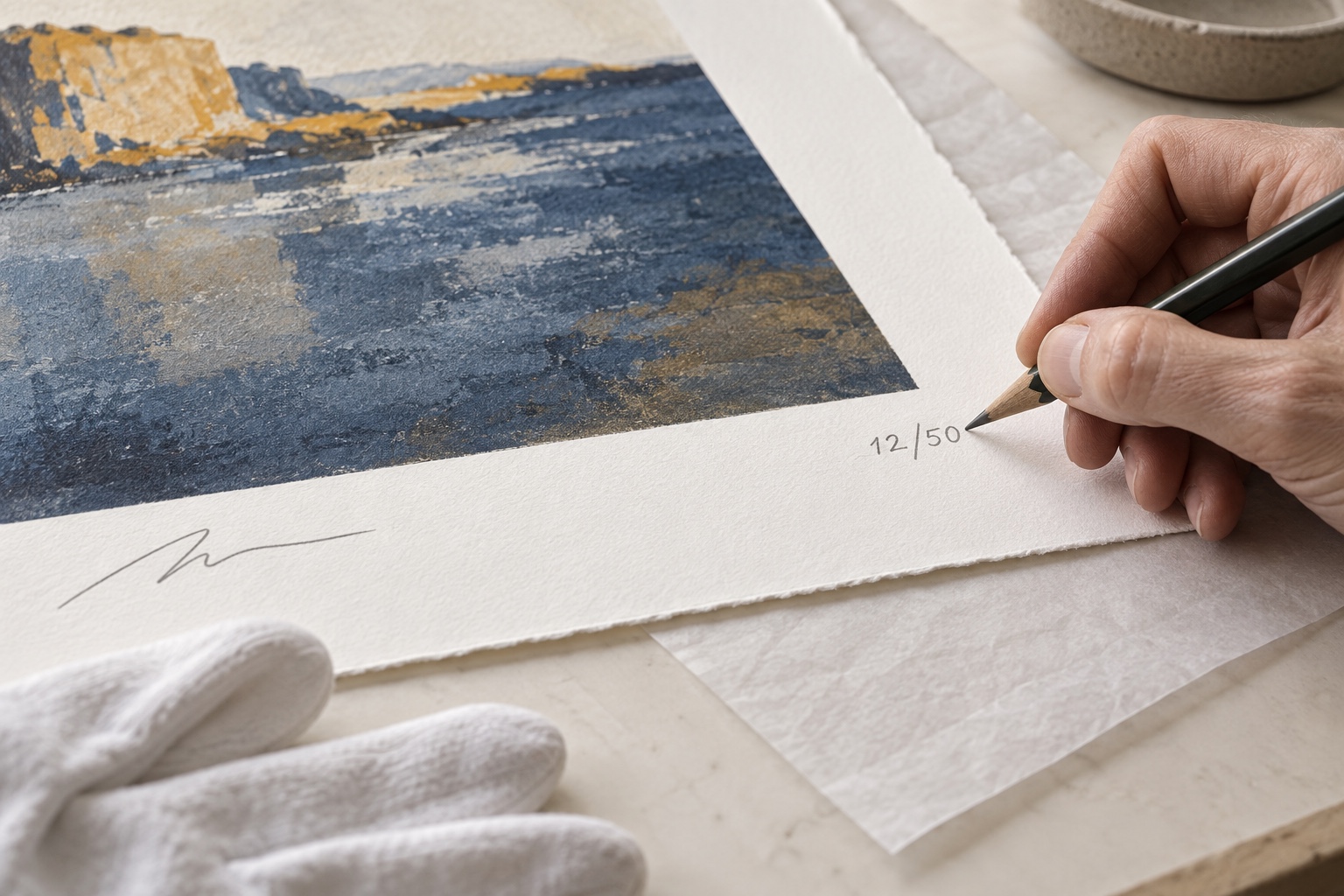
Sign and number in soft pencil (a B or 2B is ideal), not pen. Pencil is the long established convention for fine art prints, cannot be reproduced by a printer, and will not bleed or fade. The usual layout is:
- Bottom left: the edition number, written as a fraction, for example 12/50.
- Bottom centre: the title (optional).
- Bottom right: your signature and often the year.
This is why a white border matters. Giclée London prints with standard white borders of 25mm or 50mm, or a custom size, giving you a clean margin to sign in and a surface that sits neatly under a mount.
Artist’s proofs
Artist’s proofs, marked “AP” or “A/P”, are a small number of prints kept outside the numbered edition. A widely followed convention is to keep them to around 10% of the edition size, so an edition of 50 might have up to 5 APs. Always disclose them.
Certificate of authenticity
A certificate of authenticity reassures buyers and supports resale value. It should include:
- Artist name, artwork title and year of the original
- Edition number and total edition size (for example 12 of 50)
- Print dimensions and image dimensions
- Printing method: archival pigment giclée
- Paper name and weight, for example Hahnemühle Photo Rag 308gsm
- Your signature and the date of signing
Step 6: Presentation, mounting and framing
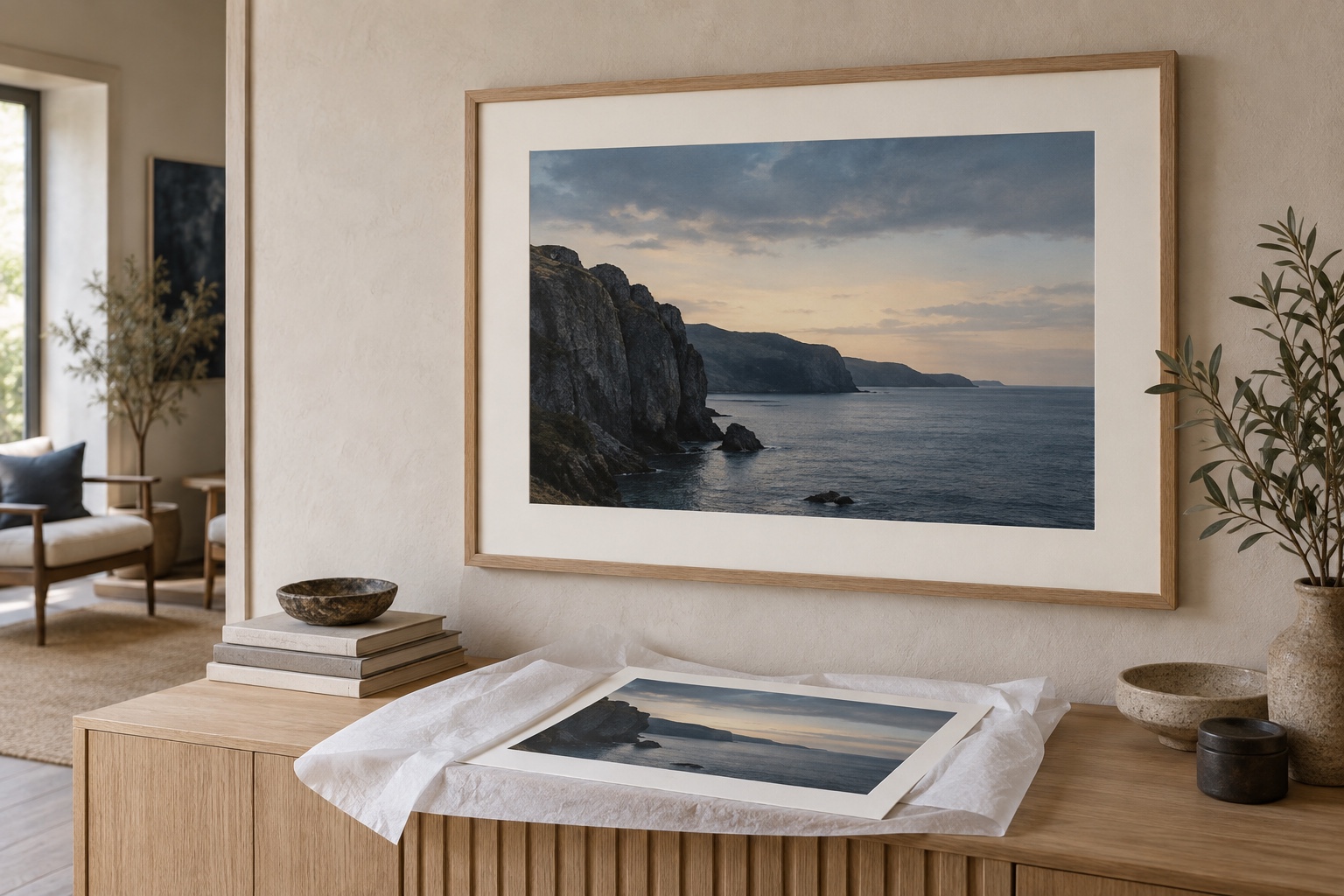
How a print arrives affects how it is valued. You can sell prints unmounted in protective sleeves, mounted with an acid free mount, or fully framed. Giclée London offers print and mount and framed prints, with solid wood mouldings in natural oak, black, white and metallic finishes, acid free mounting, and contemporary floating frame options.
How much does it cost to produce limited edition giclée prints?
Production cost depends on size and paper. As a guide, Giclée London prices (including VAT) start from:
| Size | House fine art papers | Hahnemühle papers |
|---|---|---|
| A4 | from £6.99 | from £8.74 |
| A3 | from £9.99 | from £12.49 |
| A2 | from £18.99 | from £23.74 |
| A1 | from £38.99 | from £48.74 |
| A0 | from £78.99 | from £98.74 |
Volume discounts apply on larger runs. You can get an exact figure for any size and paper using our online pricing calculator. Prices shown are a guide at the time of writing; the calculator always shows the current price.
Large format and panoramic editions
Giclée London prints up to 60 inches (1,524mm) wide on Canon imagePROGRAF PRO series printers, including the 12 colour PRO 6200, with virtually unlimited length. That makes large statement editions and panoramic formats possible.
We are the long standing printing partner for the Stephen Wiltshire Gallery, producing reproductions of Stephen’s panoramic cityscape drawings on Hahnemühle Photo Rag 308gsm, including his London Panorama at widths of 1, 2, 3 and 5 metres. In September 2026 we also printed the works and built the freestanding display for Henry Reichhold’s exhibition Lost and Found at London Bridge station as part of the Totally Thames festival.
Common mistakes to avoid
- Skipping the proof. The single most common cause of disappointment. Always approve a physical proof on your chosen paper.
- Printing from a low resolution file. A file that looks sharp on screen can look soft at A2. Aim for 300 PPI at final size.
- Changing the edition after selling. Increasing an edition size after launch damages collector trust.
- Signing in pen. Use pencil, in the margin, never on the image.
- No border. Without a margin there is nowhere to sign and number neatly.
Frequently asked questions
What is the difference between a giclée print and a lithograph?
A giclée is made on a professional pigment inkjet printer from a digital file. A traditional lithograph is made by printing from a prepared stone or plate. Modern “offset lithographs” are commercial prints typically used for posters. For reproducing artwork in small, archival editions, giclée offers wider colour range, finer detail and no setup costs.
How long do giclée prints last?
Printed with archival pigment inks on acid free cotton paper and displayed away from direct sunlight, giclée prints are rated to last 80 to over 100 years without noticeable fading.
Can I print a limited edition one print at a time?
Yes. Giclée London has no minimum order, and monthly calibration keeps colour consistent across prints made weeks or months apart.
How long does giclée printing take?
Standard orders are completed within 3 to 5 working days of payment, with tracked courier delivery across the UK mainland and international shipping available. Local collection is also available.
Where can I get limited edition giclée prints made in London?
Giclée London is a fine art print studio serving London and the Home Counties, with UK wide and international delivery. You can order online, call 01182 076591 or email sales@gicleelondon.co.uk.
Ready to create your edition?
Whether you are releasing your first edition of 25 or producing a 5 metre panorama, Giclée London combines archival Canon pigment printing, Hahnemühle, Innova and Origin papers, and careful colour proofing so every print in your edition matches the one before it. Every order is covered by our Quality Guarantee.